Words by Erik Vroons
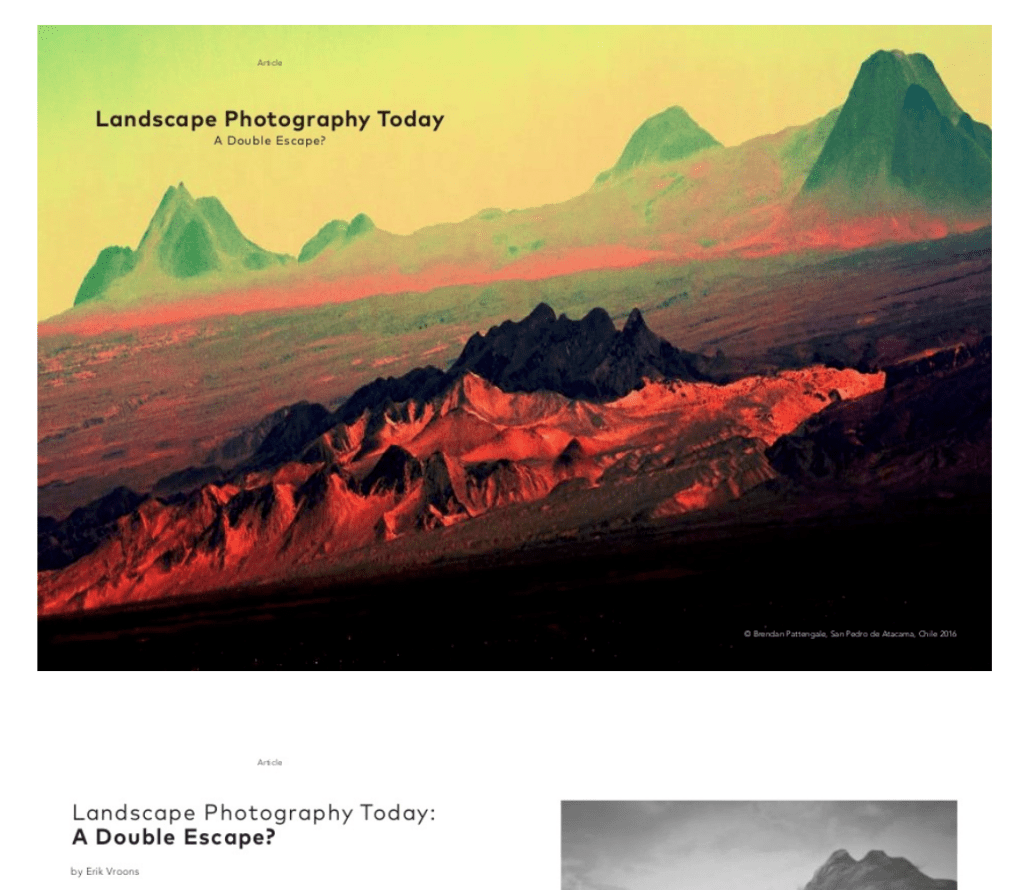
“Brendon Pattengale (1984-) express a desire to work side the landscape traditions while utilising an unorthodox set of tools to capture the overly fimiliar panoramas of mountainous landscapes, as once captured by both the Pictirialisys and the Realisys. Considering the camera as a glorified paintbrush, Pattengale’s Color of Love, revives historic photographic processes but also makes use of innovative techniques and unconventional equipment and chemistry. he manipulates materials the distinction between observed and constructed imaginary
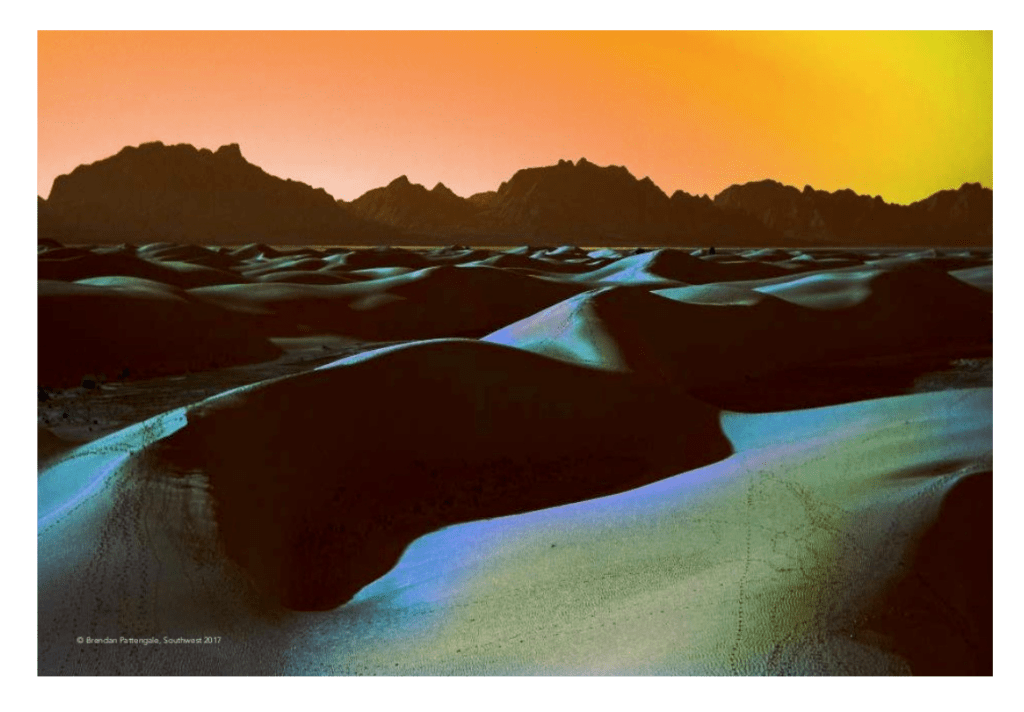
Pattengale developed an interest in landscape photography as a child when backpacking with parents as a child, when backpacking with his parents (and two older brothers) in California’s eastern Sierra Nevada mountains. now that he is able to match his ideas with what is coming out of his camera, Pattengale is not willing to fully explain his methods. But it can also be said that he makes use of full spectrum photography, an imaging process whereby the camera os modified to capture everything in from ultraviolet to infrared light
these landscape photographs might maintain a certain realism in the way that they vividly depict valleys and vistas as once painted by the famous American modernist artist Georgia O’Keeffe(1887-1986). indeed, this is no coincidence that Pattengale’s passion for landscapes, particularly the American west, really took off after the trip a few years ago to ghost ranch, Okeeffe’s former home in New Mexico
known as a loner, and wishing to escape the hurlyburly of new york city, O’Keeffe explored the land she refers to as the “the faraway’. on her first visit to New Mexico in 1917, she was instantly drawn to the stark beauty of its unusual forms, in both the architecture and the landscape. she constantly departing from the overall shape and form. it is exactly this of phenomenological reduction that we can now see in the strikingly abstract, or even psychedelic, landscape photography of Pattengale – who also visited California, Bolivia, Chile, and Iceland for his Color of Love project.
is it still “photographic”, though? palatinate’s choice of perspective and colour scheme results in images that appear deceptively more like drawings or paintings than photography. yet, before anything, what seems to be of concern here is a conceptual evaluation of the landscape representation. the medium of photography matters, but mostly in the sense of it having its own art-historical history with regards to the transcendence of majestic scenery such as the American west
aesthetic ideas such as the picturesque and the sublime have informed thinking about what a landscape is and how we look at it, and this new attempt, to seek alternative aesthetic approaches and, with that to escape the cliched depiction of nature encourages the viewers to reconsider the beauty if seemingly untarnished landscapes with fresh etes.
alongside serverak other arists of his generation who are concerned with creative approaches to lansacpe photography (such as Cody Cobb, Douglass Mandry, and Matthew Brant), Brendan Pattengale- awoken to wonder by following in the footsteps of so many great creative minds that once roamed this planet- is passionately searching for the subliminal effect by way of a new visual language.
trying to present an unanticipated and captivating visual experience is something that should be appreciated, of course, but the question remains: how abiding is the avant garde pictorial approach? will it indeed result in an enduring escape from our mundane way of seeing, or will it lose, over time, its initial ability to overcome the force of the canon? alas, such been the tragedy of so any artists. ” Gup Vol 61, pp 14-21 Xpublishers (2019)
 Alex's Photos & Thoughts